


By Matik Kueth
The National Democratic Movement (NDM) has questioned the legality of the recent amendment to South Sudan’s peace agreement, arguing that the process did not follow the procedures required under the agreement and the Constitution.
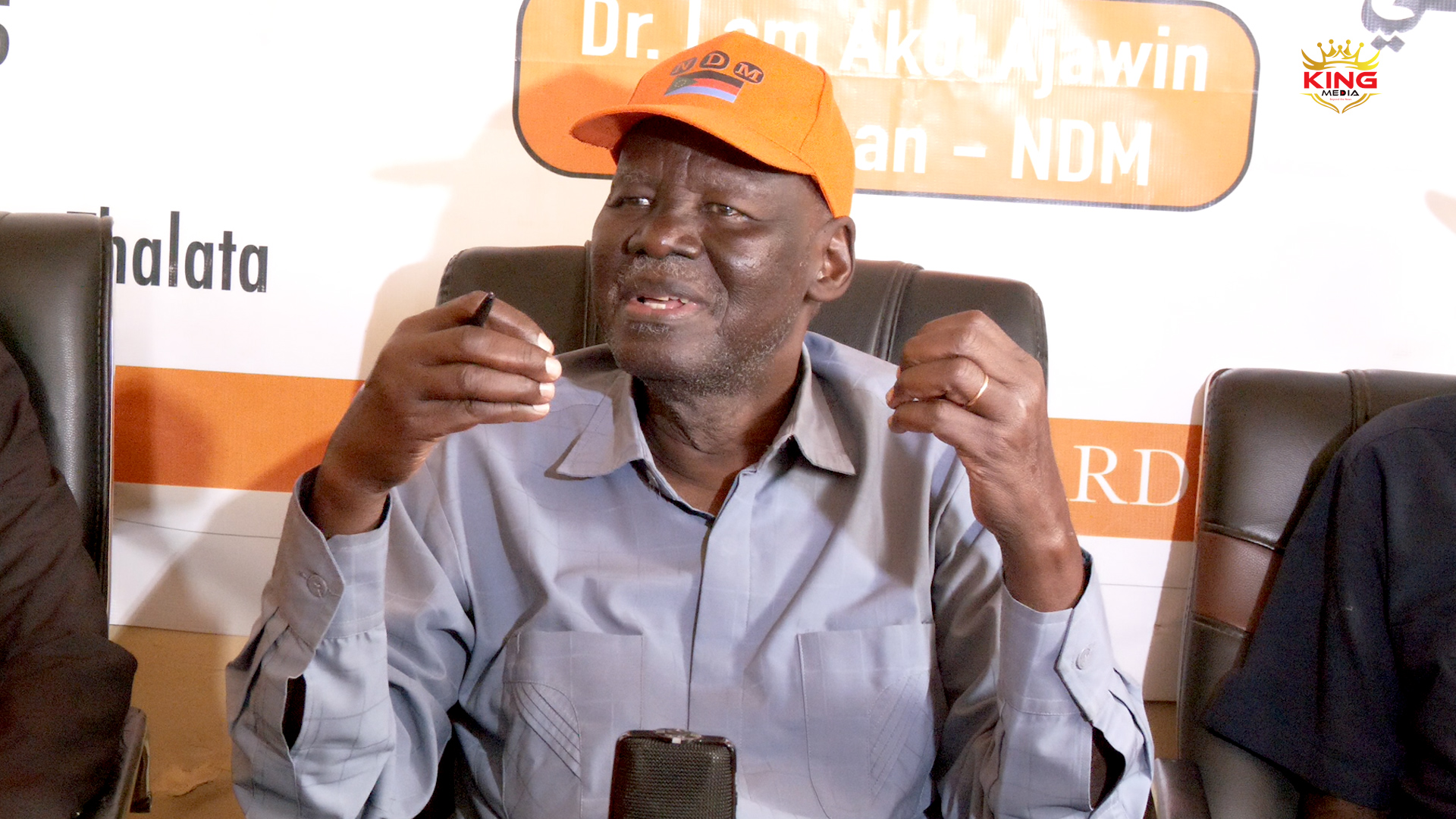
While addressing a press conference in Juba on Friday, NDM leader Dr. Lam Akol stated that the amendment process must meet specific legal requirements before it can be considered valid.
“There are parties without which, if all of them are not there, the amendment is not valid. First of all, the signatories must have a consensus on that amendment. Second, that amendment is taken to the Council of Ministers,” Dr. Akol said.
He added, “They must approve it by a majority of two-thirds. Third, it must go to RJMEC and be approved by two-thirds of the voting members, because RJMEC are not all voting members. Fourth, and finally, to be ratified by Parliament.”
He explained that the procedures require consensus among the signatories to the agreement, approval by the Council of Ministers, endorsement by the Reconstituted Joint Monitoring and Evaluation Commission (RJMEC), and final ratification by Parliament.
Akol argued that these steps were not fully followed, saying the lack of agreement among political parties had already undermined the process.
“First, there was no consensus among the political parties. So already Article 8.4 has been violated,” he said.
The NDM leader also questioned the parliamentary process through which the amendment was approved, saying it did not comply with constitutional requirements.
“The two houses of Parliament did not sit separately,” he stressed, referring to the National Legislative Assembly and the Council of States.
He further argued that the amendment bill was not given enough time for consideration as required by the Constitution.
“The bill that was tabled was not given one month. As soon as it was tabled, the Speaker said, take it to the committee to report back in two weeks,” he stated.
Based on these concerns, he said the legality of the amendment remains questionable.
“So, if you consider all these, the amendment is ultra vires,” he noted, using the legal term for an action taken beyond lawful authority.
The NDM leader’s concern over the amendment comes as South Sudan moves toward planned elections in December 2026, following years of delays under the transitional arrangements established by the 2018 Revitalized Peace Agreement.
Peace monitors and international partners have continued to urge South Sudan’s leaders to ensure that outstanding provisions of the agreement are addressed to create conditions for credible elections, but nothing has yielded fruit.
However, Akol stated that the legal process behind the amendment must be addressed before the country proceeds further.
He added that the credibility of the electoral process also depends on the independence of institutions overseeing the polls, particularly the National Election Commission (NEC).
“The National Election Commission must be made of people who are non-partisan, who do not belong to parties, and whose names must be taken to Parliament for vetting,” he said.