


By Matik Kueth
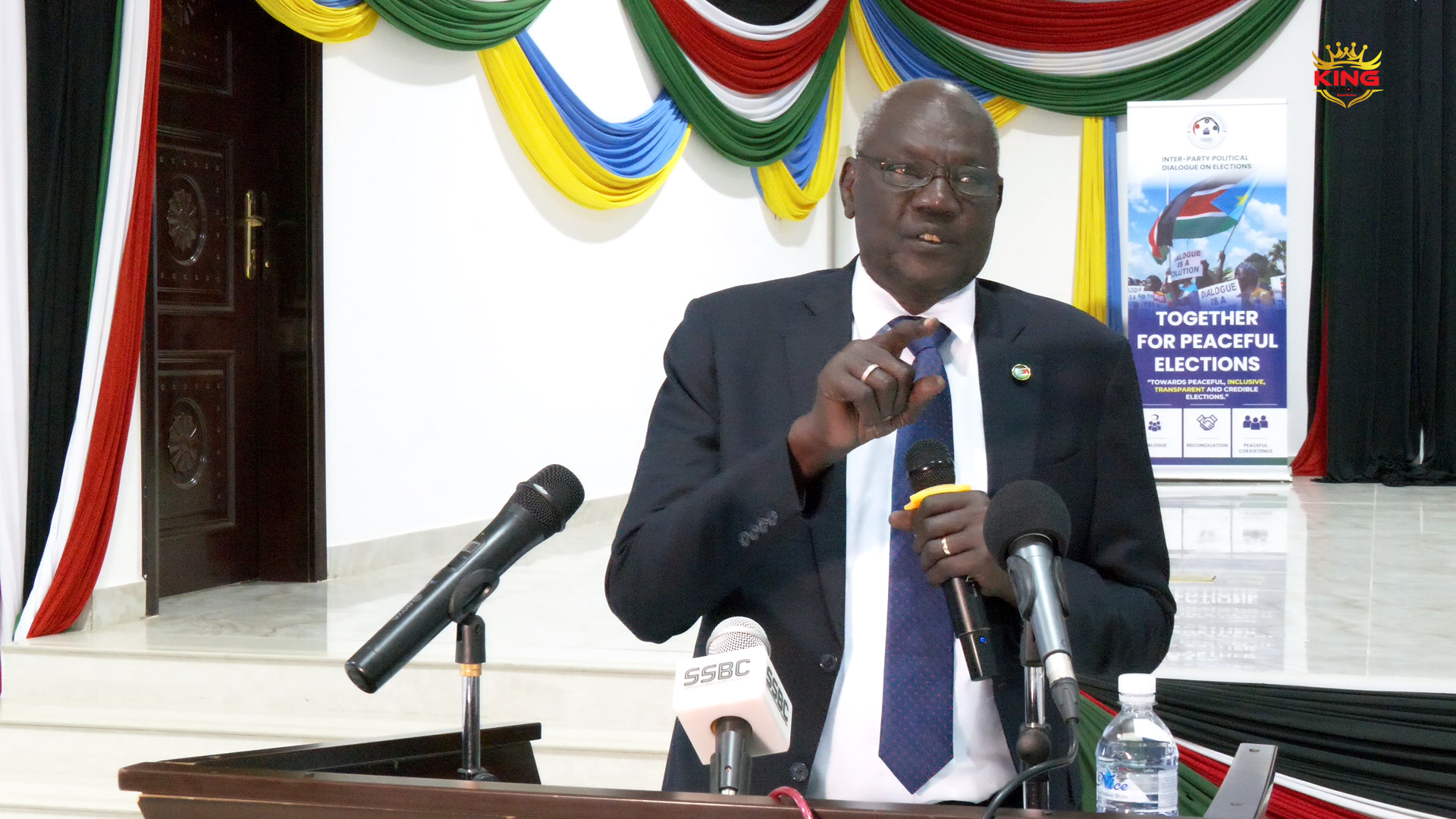
The Minister of East African Community Affairs (EAC), Michael Makuei Lueth, has clarified that the December 22 general elections will cover the presidency, governorships, national and state legislatures, the Council of States and administrative-area councils, while local-government elections will be held separately.
Makuei, who spoke at the Inter-Party-Political Dialogue in Juba on Tuesday, said the December polls constitute general elections and are not limited to executive or legislative positions.
He stated that local-government elections would be conducted later in accordance with the Local Government Act.
“The modality is general elections. By general elections, we don’t mean executive elections or legislative elections or partial elections,” Makuei said.
Makuei noted that the December polls would include elections for the president, governors, the National Legislative Assembly, Council of States, state assemblies and administrative-area councils.
“So, by general elections, there will be elections for the President. There will be elections for the Governors. There will be elections for the National Assembly, National Legislative Assembly, for the Council of States, for the state assemblies and the administrative area councils. All these elections will be conducted. The only area where elections will not be conducted is the local government level,” he stated.
“Because this is a third tier of the government. And this third tier of the government, elections for that will be conducted separately. So, to conduct local government elections in accordance with the provisions of the Local Government Act,” he added.
Makuei Clip 2……
He urged political parties to respect the existing legal framework throughout the electoral cycle, arguing that the laws governing the process have already been amended to facilitate the December vote.
“That is, whatever legal institutions that we have introduced, we need to abide by them from now up to the polling. And during the polling and after the outcome of the elections,” he noted.
Makuei said the government considers the legal framework for the elections largely settled and further called on political parties to use established legal and political mechanisms to address disputes.
“Of course, there has been a talk here of all the issues that were raised here; most of them are addressed in the national election law,” he said.
He added that electoral courts and legal counsels were being prepared to handle election-related matters.
The EAC minister also stressed that the government expects all registered political parties to participate in the elections and urged continued engagement with groups that are not taking part in the dialogue or electoral process.
He underlined that the post-election government would have to continue discussions with non-participating groups and address outstanding national issues, including permanent constitution-making, a population and housing census, security-sector reform, economic reforms, refugee repatriation, IDP resettlement, and national healing and reconciliation.
The inter-party dialogue comes amid differing positions among political actors over the electoral process.
While the government and ruling SPLM have reaffirmed their commitment to the December polls, the SPLM-IO has rejected the planned elections, arguing that they lack sufficient consensus among the parties to the 2018 peace agreement.
Makuei nevertheless said the SPLM remains committed to the elections and to respecting their outcome, adding that the election date is not for political parties to change.
“After all the parties, all the political parties shall abide by and commit themselves to the outcome of the general elections. In case of any dispute, parties may resort to legal redress. One thing that the National Election Commission cannot do is amend the date,” he stressed.