


By William Madouk
Mr. Gabriel Bol Deng Majok has stepped into the shoes of Professor Abednego Akok Kacuol at a critical moment in South Sudan’s long journey towards elections.
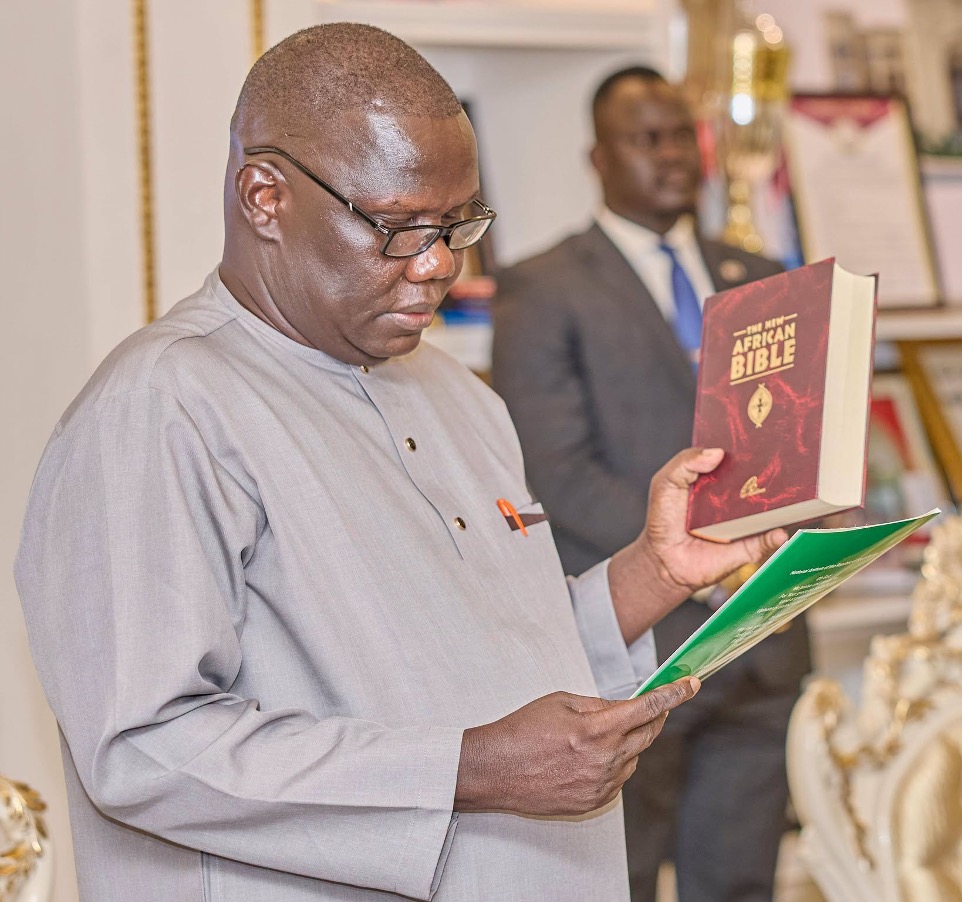
Sworn in as the new chairperson of the National Elections Commission (NEC), Deng takes charge with about 90 days remaining before the country’s scheduled elections in December.
He also inherits the work of a predecessor he described as his uncle, leader and adviser.
“We will not reinvent the wheel, rather we will continue from where my predecessor, my uncle, my leader professor Abenego and the commission have reached while strengthening and improving the work where necessary,” Deng said.
The leadership change comes just months before the planned vote. President Salva Kiir removed Professor Abednego as NEC chairperson and appointed Deng, who had been serving as secretary-general, as his replacement. No public reason was given for the change.
Deng said the change would not disrupt preparations.
“I therefore call upon his excellency the President of the Republic and the people of South Sudan that the transition in the leadership of the commission will not interrupt or undermine the progress and operations for general elections in December,” he said.
A long wait for the ballot box
South Sudan became independent in 2011 but has never held a national election since independence.
A civil war erupted in 2013, followed by the 2018 peace agreement between President Salva Kiir and opposition leader Riek Machar.
The agreement created a transitional government and set a path towards elections. But the vote was repeatedly delayed as political leaders struggled to implement the peace deal.
The latest timetable sets 22 December 2026 as polling day. The NEC has also been preparing electoral constituencies and other parts of the process.
Deng said the time left was short.
“As of today, we have remained with 90 days until the election day in December. The time before us is therefore limited and every day, every hour counts.”
Remembering his predecessor
Deng used his first address to pay tribute to Professor Abednego, crediting him with helping build the NEC.
“It was through his wisdom he hired all of you here and established the institution from scratch and for that we are forever grateful,” he said.
“He will always be in our heart, in our mind and again in every corner where NEC is.”
Abednego, who had led the commission since 2012 with a break before his reappointment in 2023, has also urged Deng to maintain continuity in the election preparations.
‘We only see the Republic of South Sudan’
Deng said the NEC must remain above political competition.
“NEC is a blind institution; it doesn’t see the color, it doesn’t see the tribe, we don’t see the color of any political party, we only see the Republic of South Sudan, we only see and believe in the interests of our citizens.”
He said the commission’s focus would be the rights of voters and the national interest.
“We don’t see any politician, we don’t see any political parties, what we see is the will of the people, their rights.”
‘Ballots, not bullets’
For Deng, the purpose of the election is to give South Sudanese a peaceful way to choose their leaders.
“The National Election Commission has a sole responsibility to enable the people of South Sudan to determine the future of the country through ballots, not bullets.”
He also promised to work closely with the other commissioners and NEC staff.
“I will not be your boss. I will work with you as a colleague, a partner and a member of one team to achieve this national goal entrusted to us by the laws of South Sudan.”
Now the responsibility is his. With about 90 days left, Deng must carry forward the work of the man whose shoes he has stepped into while guiding the NEC through one of the most important periods in South Sudan’s electoral history.