


By Matik Kueth
In South Sudan’s newsrooms, where young women arrive with hopes of telling stories that can impact their country, many are instead met with whispered propositions, groping hands, and threats from the very men meant to mentor them.
Female journalists across the country are facing a hidden pandemic of sexual harassment and assault at the hands of their media managers, abuse that goes mostly unreported out of fear of job loss, retaliation, and public disgrace.
Several female journalists have shared stories of being touched inappropriately, receiving sexually suggestive messages, and being propositioned for sexual favors in exchange for promotions or job security.
The toxic environment, they said, is forcing them to abandon their careers altogether.
In an exclusive interview with King Media on Friday, Recho Dranny, a former program manager who has worked in multiple media outlets in Juba for nearly 15 years, described how she left the media after a terrible ordeal.
“There are female journalists who were sent from media institutions to come and do trainings, but most of them didn’t finish their training because of the way the manager was behaving. One time even the manager ended up holding my breasts in the studio while I was on air. And I was like, what? If this is the kind of environment we are working for, then it’s better to stay away,” she recounted.
Dranny said she eventually lost her job after refusing to give in to her manager’s advances.
“I ended up losing that job because I didn’t give him what he wanted. I realized this manager wanted to sleep with almost all the women in the radio station. So actually, this issue of sexual harassment is a very big issue here,” Dranny said.
She added, “And it needs to be addressed because female journalists are suffering in silence. Most of the people have been rendered jobless, not because they cannot perform their work. They can work very well, but because of the environment they are working in, some of them have ended up doing other things”
Dranny, who is now a businesswomen explained that the habit creates a suffocating work environment that makes it difficult for female journalists to function.
“When such kind of things happen to an individual, it always affects someone. Like you cannot be free working. You cannot work freely. You feel out of place, actually. If you’re working and always the manager is here, you know, touching you, blocking your way, sending you messages like, I want to sleep with you, something like that, touching your buttocks, you feel out of place. Nobody would love to work in such an environment,” she stressed.
Another female journalist, Amina Joseph (not her real name), shared a harrowing experience of harassment that forced her out of the profession, speaking on condition of anonymity for fear of retaliation.
“My manager told me I could be promoted if I ‘helped him out’ in private. Whenever I am on air, the manager could come and touched me inappropriately multiple times. When I told him to stop such habits, he didn’t listen. So, I had to leave quietly to protect my safety and dignity,” she revealed.
She said she loved her work, but continual harassment by her station manager forced her to quit the profession, even after reporting the case to the female journalists’ network, which took no action.
“I was passionate about my work, but the constant harassment from my station manager left me no choice but to quit. I reported the case to the Female Journalists’ Network and AMDISS, but nothing has been done,” she stressed.
Dranny and Amina’s experiences are just the tip of the iceberg; many female journalists who have faced similar harassment choose not to speak out, fearing retaliation or public disgrace.

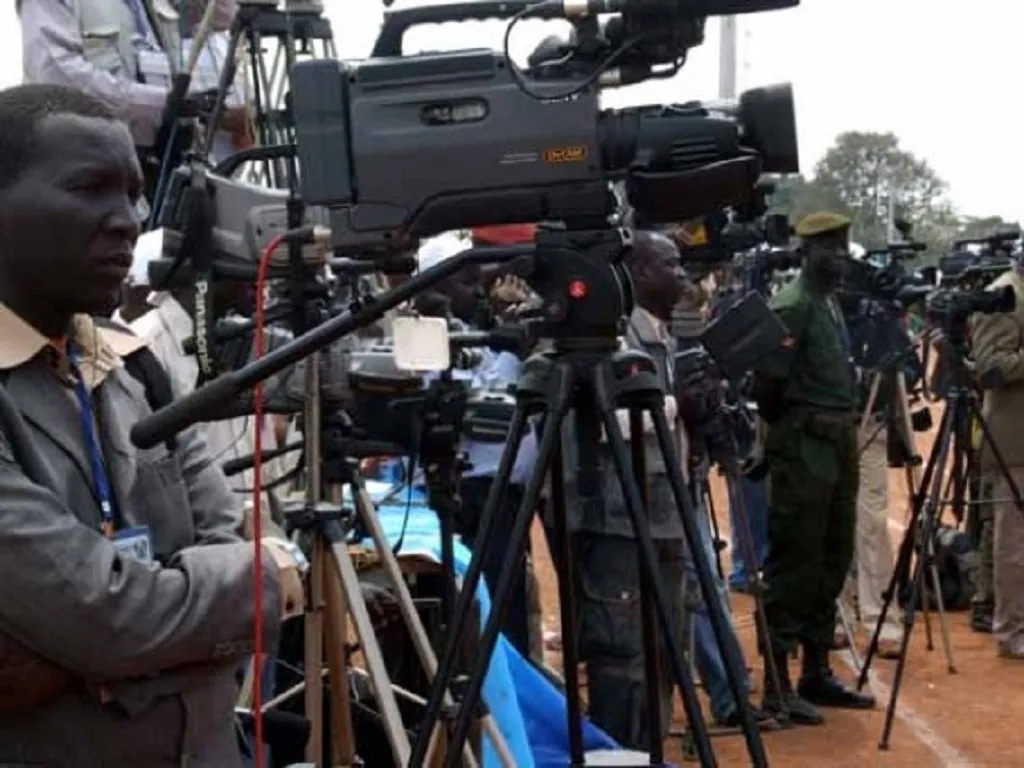
A photo of a newsroom studio and recording equipment [Photo Courtesy].
Many of the complaints received by the Female Journalists Network, including cases like Amina’s, remain unresolved due to weak institutional cooperation and the fear many women have of reporting their issues.
Zahara Sayid, Chairperson of the Female Journalists Network (FJN), states that the Network has observed an increasing number of women journalists leaving the profession, noting that these challenges hinder effective case follow-up and accountability for perpetrators.
She said most station managers are men who assign women unsafe late-night duties beyond their control, despite South Sudan’s poor security.
“We have registered several cases; the latest cases are two. Previously, there were so many cases that led to some of the female journalists abandoning their work. These females are mothers, they are wives, and they need to be home early. And there are specific tasks given to them. But the managers give them tasks which beyond their work. So, as a woman, to work alone at that time was very dangerous,” she said.
She appealed for structural reforms to create a safer and dignified working environment for female journalists.
Majak Kuany Alier, Secretary-General of the Union of Journalists of South Sudan (UJOSS), admitted that sexual harassment and gender-based violence remain widespread challenges in newsrooms, even as the union works to safeguard female journalists.
He noted that the union has taken steps to protect women in the media by advocating workplace anti-harassment policies and promoting gender equality.
“If you experience harassment, you can report safely and confidentially, and we will work with you to seek justice and protection. We are building stronger support systems so that fear never silences your voice,” he assured.
Ayaa Irene, Director of the Association for Media Development in South Sudan (AMDISS), acknowledged that while some media houses have sexual harassment policies, they remain largely ineffective.
“Despite the existence of sexual harassment policies in some South Sudanese media houses, female journalists still face harassment, often by their managers, and fear reporting due to inaction or retaliation,” Irene stated.
The AMDISS director urged media houses not only to adopt policies but also to take real action.
“Anyone who’s accused they have to set up a committee to investigate. And if they find that the person who’s accused is guilty of perpetrating sexual harassment against the female journalist, that person has to be punish even within the media house; either by giving them suspension or by dismissing from their work so that female journalists can feel that their cases are being addressed or handled,” she emphasized.
Meanwhile, Jackline Nasiwa, a human rights activist, emphasized that sexual harassment is a criminal offense under South Sudan’s Penal Code Act (Section 395), punishable by up to three years in prison.
She described it as “a form of gender-based violence and abuse of power by senior management of media houses”, urging women to speak out, cautioning that silence only deepens trauma and undermines human dignity.
Nasiwa appealed for urgent reforms to make newsrooms safe for female journalists, underscoring the need for the Media Authority and UJOSS to urgently adopt sexual harassment policies.
“The media authority needs to come out with a sexual harassment policy. The UJOSS, which is the Union of Journalists, needs to come out with that policy. So that the work environment for female journalists and even for male journalists is safe. You know sexual harassment can happen to a man or a woman, but unfortunately, it’s happening to females in this case,” she emphasized.
Although the Media Authority has not drafted policies specifically to address sexual harassment in newsrooms, its Code of Conduct for the Practice of Journalism in South Sudan clearly prohibits obtaining information “through intimidation, harassment or blackmail.”
This signifies that while the Media Authority formally recognizes harassment as unethical, the practice continues in newsrooms, posing a daunting challenge.
Nevertheless, Aya Benjamin Warille, Minister of Gender, Child, and Social Welfare, highlighted the government’s efforts to address the problem, noting that formal policies and referral mechanisms exist, but enforcement remains a challenge.
“We have practical mechanisms, referral pathways, and focal persons in all institutions to address issues of sexual harassment,” Warille said, underlining that donor-funded projects, grievance redress systems, and helplines are in place to strengthen reporting and protection.
She explained that the Ministry has integrated sexual harassment prevention into donor-funded projects, including grievance redress mechanisms and helplines, and supports the training of staff to detect and report cases.
Warille also acknowledged the constraints limiting enforcement, including limited capacity, weak justice systems, and cultural barriers.
“We are sure that there are many cases out there. People are not reporting because there’s no service provider or they don’t even know that these policies exist. They don’t know that there are people out there to support them. The other one is the weak justice sector and impunity,” she stressed.
“These are cases where they are supposed to go to court. Not everybody has access to court and somehow they have negative thoughts about the court because of the level of impunity. We know that these abuses happen, and we’ve seen cases of people who are supposed to be locked in, they’re free out there. So, such examples discourage people from reporting because the idea of reporting is to hold somebody accountable. These are issues that we deal with,” she emphasized.
According to a recent Female Journalists Network (FJN) report, 30 female journalists across South Sudan reported experiencing sexual harassment in the workplace and in the field, with many alleging that the perpetrators were editors, managers, or government officials.
In 2019, two female journalists were physically assaulted by an army officer during an assignment at the SSPDF Headquarters, triggering public condemnation and a rare apology from military authorities.
Though some media houses have sexual harassment policies in place, the lack of enforcement continues to silence survivors, force women out of journalism, and undermine respect for female employees, all while exacerbating gender disparities in the country’s media.
“This story is reported with a grant from Journalists for Human Rights under the ‘Tackling Mis/Disinformation Project,’ funded by the Peace and Stabilization Program of the Government of Canada.”